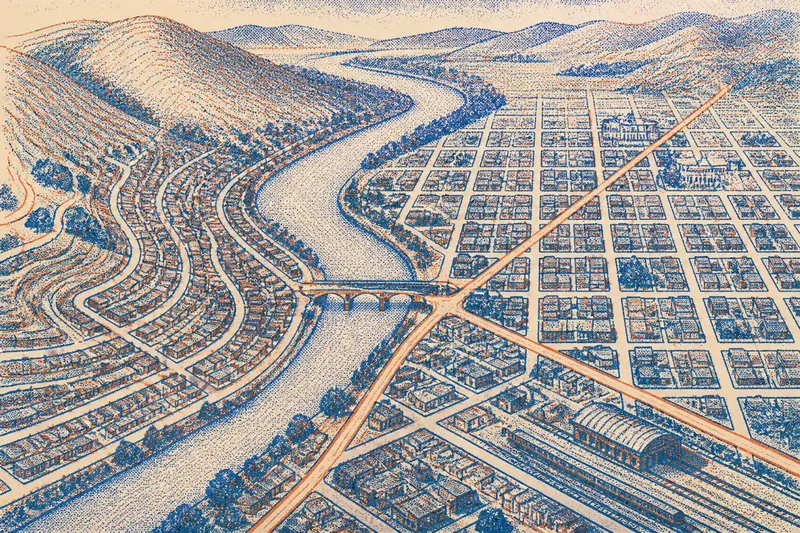
A Plaza, a Square, and the Space Between
Compare plaza and square design by reading their shapes, edges, and surrounding uses, so you can describe how each space opens, encloses, and connects.
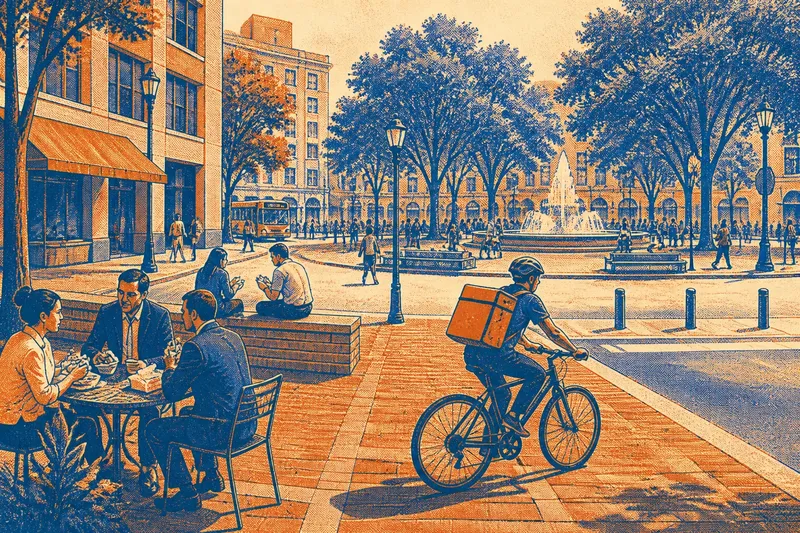
At the corner of a brick plaza, a delivery cyclist cuts across the paving while office workers eat lunch beside a low wall. A few blocks away, a square holds a fountain behind a ring of trees. To compare a plaza and a square, look beyond their names: shape, edges, and neighboring uses show how each space meets the city.
Read the outline before naming the space
A square often has a legible outline. Its sides may follow streets or building fronts, making the open area feel like a room with a recognizable perimeter. The shape need not be a perfect rectangle. What matters is whether a person can readily see where the space begins and where the surrounding blocks take over.
A plaza can be less regular. It may widen from a sidewalk, spread around a civic building, or stretch along a busy route. Its boundaries can feel provisional: paving, planters, steps, or a change in traffic may mark an edge without enclosing the whole space.
Stand at one entrance and trace the visible perimeter with your eyes. If the open ground reads as a distinct whole, “square” may help describe its form. If it seems to spill into paths, forecourts, and adjacent sidewalks, “plaza” may better capture its relation to the city. These are useful descriptions, not fixed rules; local usage may call a place by either name.
Notice whether the edges make a room
Edges shape the feeling of enclosure. Continuous building fronts, arcades, and closely spaced entrances give a space a firm frame. A person sitting near the middle can still feel connected to the surrounding streets, but the perimeter makes the open center easier to grasp.
By contrast, a plaza edged by a broad road, a blank wall, or scattered structures may feel exposed, even if it is small. Trees and canopies soften that exposure without making a solid boundary. A row of benches can suggest where people are expected to pause, while a line of bollards may separate walking space from vehicles.
Ask what holds the edge together. Is it a wall, a repeated row of storefronts, a canopy, or simply a shift in paving? The answer gives you more precise language than calling a place “open” or “closed.” You can say that a square feels enclosed by continuous façades, or that a plaza feels porous because paths cross its edges in several directions.
Follow the uses around the perimeter
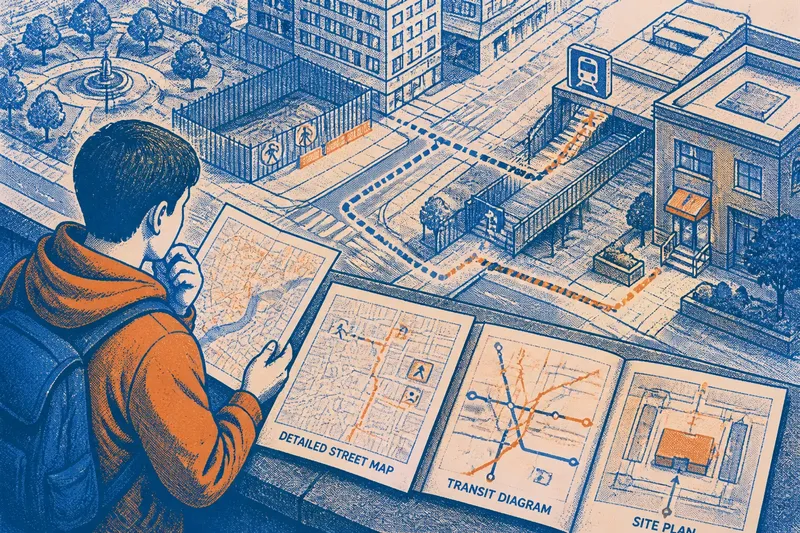
A public space does not work alone. Cafés, transit stops, libraries, shops, government buildings, and apartment entrances each bring a different rhythm to its edge. Doors that open directly onto a square can keep activity close to the center. A plaza beside a transit entrance may instead function as a passage between platforms, sidewalks, and nearby blocks.
Look at what people can do without leaving the space. Can someone buy a drink, sit in shade, wait for a bus, or enter a public building? Several kinds of nearby use can make a place feel connected to ordinary routines. A single monumental building may give it civic importance but leave fewer reasons to linger at the edges.
Say you are describing a paved forecourt beside a library and a bus stop. If people cross it on their way between the stop, library doors, and shops, you might call it a connected plaza. If a compact set of building fronts wraps around a central seating area and gives the space a clear boundary, you could describe it as square-like, even if its official name says “plaza.”
Watch how routes pass through the open ground
The paths through a space reveal whether it gathers movement or channels it. A square often has a center that people can enter from several sides, then choose to cross or occupy. A plaza may be arranged as a route: paving, steps, or an aligned doorway can draw people toward a station, waterfront, or civic entrance.
Notice where walking lines converge. A diagonal track across a lawn, a worn route between benches, or a broad paved corridor may show the most direct connection between destinations. If those routes divide the space into separate pockets, describe that effect rather than treating the whole plaza as one undifferentiated area.
Movement also changes how edges feel. A busy crossing can make one side seem open to the neighborhood, while a curb or traffic lane makes the opposite side harder to reach. A place can therefore be visually open yet poorly connected on foot. Describe both the view and the route: they are not the same thing.
Compare shade, seating, and the scale of the center
The center may invite people to stay, or it may remain mostly clear for circulation and gatherings. Trees, movable chairs, fountains, and low walls give people choices about where to pause. A large empty paved area may look expansive but offer little reason to occupy its middle on an ordinary day.
Compare the center with its edges. If seating sits only along the perimeter, the middle can feel like a stage or a route through. If small clusters of seats and trees break up the open ground, the space may feel more intimate. Neither arrangement is automatically better; each supports a different relation between passing through and staying put.
When describing scale, consider the person rather than the plan alone. A broad view across paving may feel generous from a busy sidewalk, while a close canopy or a line of benches can make a much larger space feel legible at walking speed. Concrete observations help: “tree shade covers the seating edge” says more than “the plaza is welcoming.”
Questions that sharpen a plaza and square comparison?
Is every square enclosed by buildings?
No. Streets, trees, walls, and other features can establish a square’s boundary. The useful question is whether the edges make the open area read as a distinct place.
Can a plaza feel enclosed?
Yes. A plaza surrounded by buildings, arcades, or planted edges can feel like a room. Its name does not decide how enclosed it feels to someone standing there.
What should I notice first when comparing two spaces?
Begin with the outline and the strongest edges, then look at entrances and nearby uses. That sequence makes it easier to explain why one space feels contained while another seems to continue into the street network.
Use the name, then describe the evidence
Place names are clues, not complete descriptions. A city may call a space a square because that name stuck, while its current form behaves more like a plaza; another may use “plaza” for a tightly framed civic center. Keep the local name, then add what a walker can verify: the shape, the edges, the routes, and the uses facing the open ground.
That method makes a comparison useful to someone who has never visited. Instead of arguing over whether a place is truly a plaza or square, explain how its boundaries gather people, how its paths connect destinations, and where the city presses close or falls away. The distinction becomes a way to read the public space, not a label that ends the conversation.