When a Street Name Outlives Its First Meaning
Learn how to read an old street name against maps, buildings, and local records so it can point toward a city's past without settling the question.
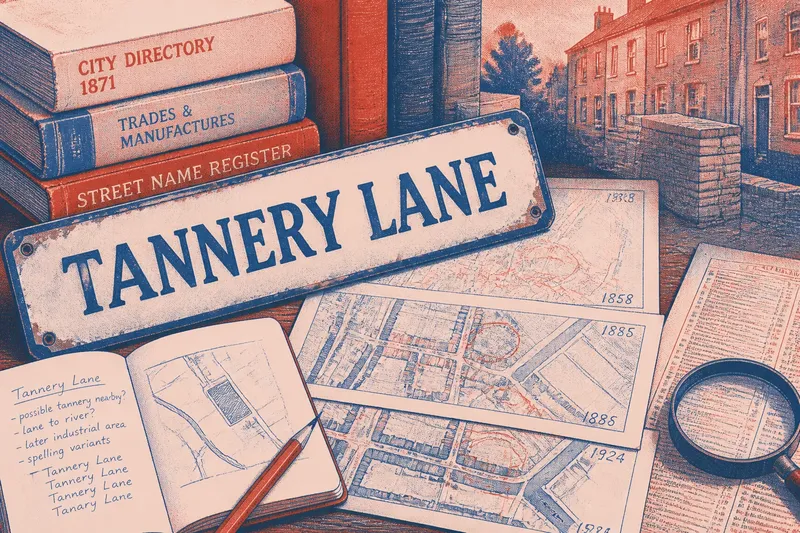
On a walk, a sign reading Tannery Lane can feel like a small clue: perhaps leather once dried nearby, perhaps the name came from something else. Street names often outlive the trades, landmarks, and people they refer to. Reading them well means treating a name as an invitation to investigate, not as proof of what happened.
A street name is a surviving label, not a full record
Names are useful because they can keep an older association visible after its original setting has changed. A wharf may be filled in, a market moved, or a workshop replaced by apartments, while the street sign remains. The name links today’s route to an earlier way of describing the neighborhood.
But a label does not explain its own origin. A street called Mill Road may have led to a mill, taken its name from a property owner, or acquired the name through a later convention. Even a plausible reading is only one possibility until other evidence supports it.
Names also change in form. A long phrase may be shortened, a spelling regularized, or a local pronunciation recorded differently by mapmakers. A current sign can preserve the broad sound of an older name while obscuring the detail that would identify its first reference.
Trades and landmarks leave different kinds of clues
A name associated with a trade often points to activity that once gathered in a particular area. Foundry Street, Brewers Row, or Tannery Lane may suggest production, storage, or a cluster of businesses. The reference could have described a whole district rather than a single building, and the activity may have shifted well before the street received its present name.
Landmark names can be similarly indirect. A street named for a ferry, gate, well, or bridge may preserve a route to something that has disappeared. The name might refer to a structure just beyond the street, not one that stood on it. Nearby changes in a riverbank, road alignment, or property boundary can make the old relationship hard to see on the ground.
Names honoring people pose another difficulty. A person may have been a landowner, official, donor, or local figure; the name by itself does not tell which connection mattered. It may even commemorate someone whose association with the neighborhood was brief. That uncertainty is a reason to look for records, not to fill gaps with a confident-sounding story.
Compare the name with evidence that can be checked
Begin with maps from different periods, if a local library, archive, or municipal map collection makes them available. Look for changes in the street’s spelling and for nearby features that could explain the name. A map can show that a canal, market, or industrial building existed in the area, though it cannot by itself prove that the feature supplied the street name.
Then look for records that connect the name to a specific source. City directories, property maps, planning documents, business listings, and local histories may describe an establishment or a naming decision. A street-name register, where one exists, can offer a direct explanation, but its wording and sources still deserve attention.
Physical surroundings provide another kind of evidence. An old stone wall, a surviving workshop, or a lane that points toward a former crossing may help explain a name’s geography. These clues are strongest when they match documentary evidence; a building that looks old is not automatically the building a street was named for.
Imagine a reader sees Foundry Street beside a row of newer homes. An older map shows a foundry marked nearby, while a directory lists the business at a matching address; a later map shows the site redeveloped. Together, those details make the trade connection plausible and trace its changing setting. If the address or dates do not line up, the street name remains a clue, not a settled account.
Why can the same street name have more than one explanation?
Could a street be named for a business that was never on it?
Yes. A name may refer to a nearby establishment, a route leading to it, or an area known for that trade. Check older maps and directories before assuming the business occupied the street itself.
Does a name prove that a landmark once stood there?
No. It may preserve a connection to a landmark elsewhere, or to a feature that moved or disappeared. Look for maps and records that place the feature in relation to the street.
What if old maps spell the street differently?
Variation can reflect changing conventions, transcription, or a shortened local name. Compare several maps and records, and note the forms rather than treating one spelling as definitive.
Changing surroundings can preserve a name and erase its context
Urban change often removes the evidence that once made a name immediately clear. A market can become a transport hub; a stream can be culverted; an industrial yard can turn into housing. The name may survive because it is embedded in addresses, directions, and residents’ habits, even when the original reference is no longer visible.
That survival is not always passive. A name can be retained, revived, or reassigned when a street is built or renamed. A new road may borrow the name of an older lane nearby, creating continuity in wording without preserving the exact route. When tracing an origin, distinguish the history of the name from the history of the street’s present alignment.
Names can also carry competing local memories. Residents may connect a street with a trade, while a civic record attributes it to a person or estate. Those accounts need not be equally supported, but the difference itself can show how neighborhood knowledge and official naming records developed separately.
Keep the claim as narrow as the evidence
A careful account separates what a name suggests from what a record documents. “The name may refer to a nearby tannery” leaves room for uncertainty. “The street was named for a tannery at this address” calls for evidence that ties the naming decision to that business and place.
For a reader tracing a name, a useful note can record the current form, older spellings, candidate references, and the source for each one. Marking which parts are documented and which remain uncertain makes the account easier to revisit if another map or record turns up.
When a street name outlives its first meaning, it still offers a way into the city’s past, but not a shortcut through it. The most useful next question is often spatial: what changed around this street that could have made the original reference disappear? That question keeps the name connected to a living urban landscape, while leaving the historical claim open to evidence.