A Rainy Afternoon Under the City Arcade
A city arcade turns a rainy walk into close reading: follow its thresholds, routes, shopfronts, and openings to see how shelter joins street to city.
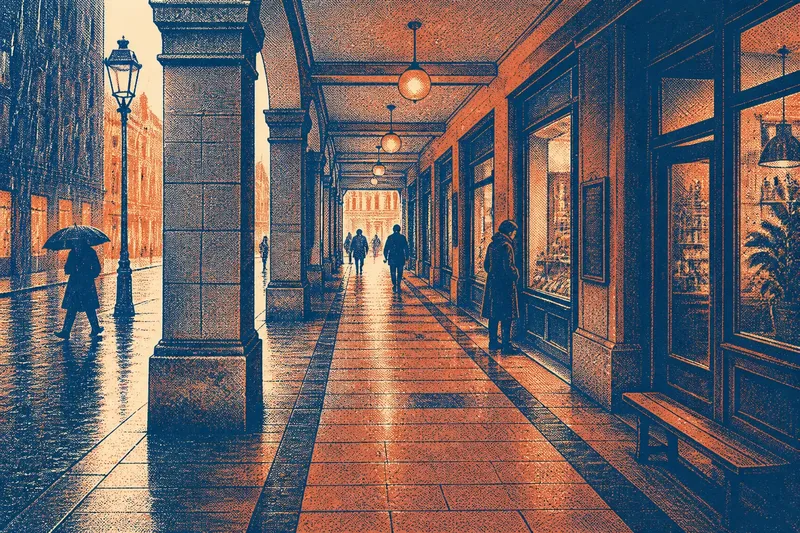
Rain gathers along the curb as you step beneath a city arcade, and the sound changes before the view does. Water still sweeps past the entrance, but overhead cover makes room for slower looking. A rainy afternoon under a city arcade can reveal how a passage belongs both to the street and to the buildings that frame it.
Choose an arcade you can enter freely, with a clear public route and places where pausing will not obstruct others. Bring a small notebook or use a notes app, but keep your attention on the passage rather than trying to record every detail. Walk it in order: from the wet street, through the threshold, along its route, and back out to the weather.
Begin where the street meets the arcade
Stand just outside the entrance for a moment. Notice how the arcade announces itself. It may be a broad opening cut into a block, a narrow passage between shops, or a covered walk that runs along the building face. Look for the first change in paving, roofline, light, or sound. These small shifts tell you where the sheltered space begins, even when there is no gate or sign.
Watch the rain at the edge. Does the roof end flush with the sidewalk, or does it project over the curb? Water may fall in a line, collect near a drain, or blow beneath the cover. Notice where people adjust their pace, shake umbrellas, or pause to let someone pass. The entrance is not just a doorway; it is a working seam between exposed street and sheltered route.
Now look outward from beneath the cover. The street may appear framed by columns, shop windows, or a low ceiling. Observe whether the opening preserves a broad view of the opposite sidewalk or narrows it to a slice. That frame changes how the street is read: traffic and pedestrians continue beyond, but the arcade gives you a defined place from which to watch.
Read the threshold before walking through
Approach the entrance slowly and note what your feet encounter. A change from rough sidewalk slabs to smooth stone can mark entry without a sign. A shallow step, a strip of metal, or a band of tile may serve as a boundary. Do not assume that a decorative line marks the property edge; simply record where the surface changes and whether the route remains easy to follow.
Look up as well as down. The arcade’s roof may begin at the level of the storefronts, sit beneath upper-floor windows, or continue as part of a larger building. Columns can stand at the edge of the walking path, leaving the shopfronts recessed behind them. Their spacing affects the sense of passage: close supports make a sequence of bays, while wider gaps open the view toward the street.
Pay attention to the transition in sound. Rain striking a canopy may become a steady patter; footsteps can sound sharper on stone than on pavement. The street’s noise may remain clear at the entrance and soften farther inside. These changes help you sense the arcade’s depth without looking at a map. If the passage is busy, keep moving and observe from the side rather than stopping in the flow.
Follow the arcade’s route at walking pace
Walk the length of the arcade once without detouring. Notice whether it runs straight, bends, branches, or opens into another covered section. Track the route with simple landmarks: a column with a notice board, a change in floor pattern, a doorway, or a bright patch of daylight. The aim is to understand how one segment leads to the next, not to catalog every business.
As you go, look for choices offered by the layout. Does the passage invite you to continue through the block, or does it feel like a place to enter and turn back? Are there side doors that appear private, public entrances set back from the route, or openings onto a courtyard? Distinguish what you can see from what you can infer. A door’s presence alone does not tell you where it leads.
Compare the center of the walkway with its edges. People may keep to one side to avoid doorways, displays, or columns. A shop may draw attention from the route without occupying it; a bench or a recessed entrance may provide a place to pause. These arrangements shape movement quietly. The arcade can serve as a shortcut, a shopping passage, or a dry stretch of sidewalk; its layout may support more than one of these uses.
Say you enter an invented arcade from a narrow side street and notice that its paving continues toward a brighter opening, while shop doors sit in shallow recesses. Follow the paving to the far end, then look back toward the entrance. You can now see how the central line guides through-movement, while the recesses offer room for brief stops without blocking the route.
Notice how shops and openings shape the passage
Pause where the route widens, if there is room to do so. Compare the shopfronts on either side: one may be fully glazed, another set behind a column line, and another replaced by a blank wall or a doorway. Ask how much of the arcade’s life is visible from the walking path. Glass can make interiors part of the public scene, while solid surfaces make the passage feel more like a corridor.
Look for openings that connect the arcade to other parts of the block. A side passage may lead toward a courtyard; a broad gap may reveal an alley or another street. Observe whether daylight travels through from that opening and whether the rain reaches the floor nearby. These are clues to the arcade’s relationship with the larger building and street network, not proof of a route’s public status.
Consider where a person could wait without becoming an obstacle. A deep window bay, a doorway recess, or a widened corner can create a pocket beside the main line of travel. If there is no comfortable pause point, the arcade may be designed chiefly for passage. If there are several, it may also support browsing and lingering. Keep your description concrete: “wide recess beside the bakery door” says more than “welcoming space.”
What should you look for in a city arcade?
How can you tell where the arcade begins?
Look for a change in cover, paving, sound, or the alignment of columns and shopfronts. The boundary may be gradual, so record the cues rather than insisting on one exact line.
Does an arcade always connect two streets?
No. Some passages cross a block, while others end at a courtyard, a lobby, or a dead end. Follow the visible route, and do not treat an opening as a through-route until you can see where it leads.
How should you observe a busy passage?
Keep to the side, avoid blocking entrances, and make brief notes after you reach a quieter spot. The pattern of people moving around you is useful to notice, but their access and comfort come first.
What changes when the rain stops?
The arcade may remain a shortcut, but its edge becomes less defined when people no longer seek cover. Look again at the route and see which features still attract movement or invite a pause.
Turn around and read the arcade from the other end
At the far end, stop only where there is space, then look back along the route you have just walked. The entrance you used may now appear smaller, brighter, or partly hidden by columns. Notice which landmarks remain visible from this direction and which disappear behind bends or shopfronts. This reverse view reveals how the passage guides attention as well as movement.
Step toward the street without leaving the cover, if the layout allows. Compare the rain’s reach at this end with what you observed at the entrance. Does the arcade meet a busy avenue, a quiet side street, or a pedestrian lane? The street outside gives context to the passage: an opening onto a broad sidewalk can feel like an extension of public movement, while one facing a narrow lane may feel more enclosed.
Before you leave, note the route in a few plain words: “side street, covered straight passage, courtyard opening, main road.” Add one feature that changed your sense of the place, such as a low canopy, a bright cross-opening, or a row of recessed doors. This short record is more useful than a long list of impressions because it preserves the arcade’s sequence and its connection to the streets around it.
When you step back into the rain, notice how quickly the arcade’s shelter falls away. A city arcade is not separate from the street so much as a sheltered interval within it. On another rainy walk, pay attention to the thresholds and turns: they show where the city opens, narrows, and lets you continue.